
Australia’s online grocery boom is rewriting the rules for suppliers: who gets seen, who pays, and who profits. Here’s what you need to know now.
At a Glance
Online has overtaken discount to become Australia’s second-largest channel. Retailers will continue to invest to improve their delivery performance and shoppers’ digital experience, and will adapt their offerings to meet different shoppers’ missions across different fulfilment methods.
For suppliers, the implications extend beyond developing an online sales strategy. As more grocery spending moves online, the rules governing product visibility, pricing, promotions and shopper engagement are changing. Retailers are increasingly monetising their digital platforms through retail media, while suppliers face growing pressure to invest in the capabilities needed to compete across multiple channels.
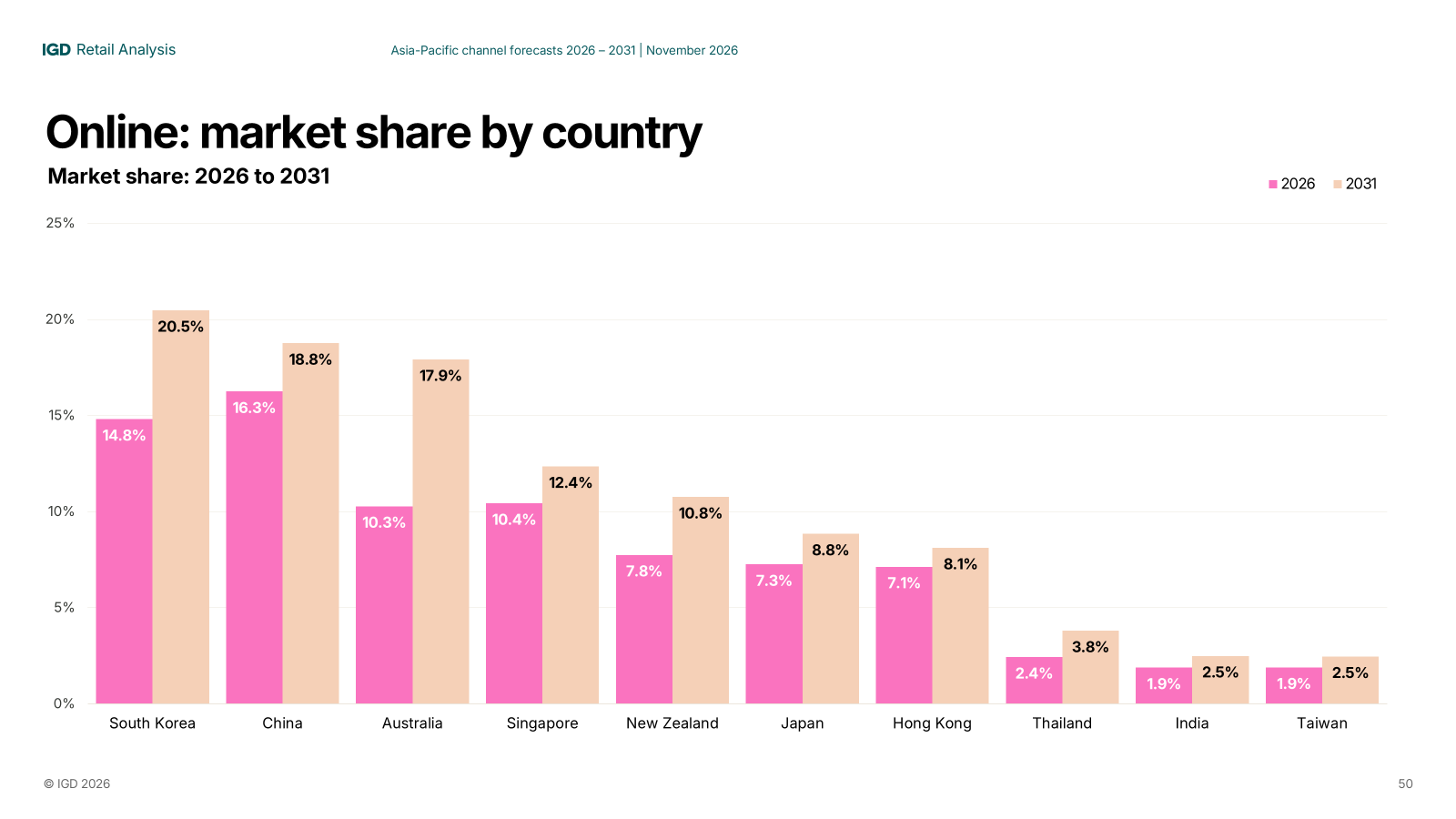
Australia will move ahead of Singapore for online penetration in APAC by 2031
Australia is on track to become one of the world's leading online grocery markets, with growth forecast to outpace most major markets in Asia-Pacific.
With a growth rate of CAGR 15.2%, Australia’s online penetration will grow from 10.3% to 17.9% by 2031, making it the third largest market for online penetration.
What is driving the growth?
Retailer investment is accelerating online adoption.
The expansion of online grocery is being supported by significant investment in technology, fulfilment infrastructure and customer propositions.
Woolworths has recently opened its AUD20 m in an automated eStore in Western Sydney to increase delivery capacity, delivery speed and improve operational efficiency. Coles continues to develop its digital capabilities, including AI-driven personalisation and demand forecasting, alongside its automated fulfilment centres developed with Ocado in Victoria and New South Wales.
Retailers are also using subscription models to encourage repeat purchasing and strengthen customer loyalty. Woolworths' Delivery Unlimited and Coles Plus offer members delivery benefits for a monthly fee, while third-party platforms such as Uber One and DoorDash's DashPass provide additional incentives for shoppers to consolidate their online spending.
Quick commerce adds another dimension to competition
Quick commerce, which provides grocery delivery in under an hour, remains a relatively small part of Australia's online grocery market but is one of its fastest-growing segments.
Coles has an exclusive on-demand partnership with Uber Eats, offering up to 17,000 products, with plans to extend the service to 500 stores. Woolworths has partnered with DoorDash while continuing its Uber Eats service and operating its own Milkrun proposition. Aldi and Costco have also partnered with DoorDash.
Despite its growth potential, the cost of rapid delivery remains a significant barrier to wider adoption.
CHOICE's price comparisons found that products purchased through delivery apps can cost substantially more than their in-store equivalents. Depending on the retailer and platform, individual basket prices were between 7% and 13% higher before delivery fees. In the most expensive Woolworths comparison, the total order cost was 39% above the equivalent in-store purchase.
This creates a clear distinction between quick commerce and conventional online grocery. While rapid delivery is suited to urgent top-up missions and convenience-led purchases, standard supermarket delivery remains more attractive for larger, planned baskets.
Suppliers should therefore consider the different shopper missions and product requirements across these platforms rather than applying a single online strategy.
What suppliers need to know
The growth of online grocery is reshaping the commercial relationship between retailers and suppliers. Four developments deserve particular attention.
1. Online visibility comes with a cost
In physical stores, product visibility is influenced by shelf position, promotional displays and merchandising. Online, these dynamics are increasingly determined by search rankings, sponsored placements, product recommendations and digital promotions.
For suppliers, retail media offers an increasingly important route to shopper engagement, particularly as consumers use retailer apps and websites to research and purchase products. However, it also introduces additional costs and raises questions around transparency and return on investment.
What suppliers should do
Treat retail media as a measurable commercial investment. Request itemised expenditure and campaign performance reporting, establish clear objectives and assess return on advertising spend by retailer. Suppliers should also distinguish between investment that drives incremental sales and spending that maintains existing online visibility.
2. Pricing and promotions face greater scrutiny
Online grocery makes it easier for shoppers to compare prices across retailers and channels. This increases price transparency and puts greater pressure on suppliers and retailers to demonstrate value.
Pricing practices are also attracting regulatory attention. The ACCC has brought Federal Court proceedings against Coles and Woolworths relating to discount pricing claims associated with their Down Down and Prices Dropped campaigns.
For suppliers, the challenge is to balance competitive pricing with sustainable margins while ensuring promotional claims and funding arrangements are transparent.
What suppliers should do
Establish clear pricing and promotional strategies across physical and online channels. Ensure promotional mechanics, reference prices and funding arrangements are properly documented and defensible. Consider how price positioning differs by retailer and platform, particularly where delivery charges and service fees affect the final shopper proposition.
3. Channel fragmentation requires a more coordinated approach
The expansion of online grocery has created a more fragmented route to market. Products may now be available through retailer websites and apps, rapid delivery platforms, third-party marketplaces and subscription services.
Each platform has different product ranges, pricing structures, content requirements and shopper missions.
For suppliers, product content, availability and execution need to be consistent across multiple platforms to ensure shoppers can find and purchase products easily.
What suppliers should do
Map product distribution across all relevant online channels and regularly audit listings, including images, descriptions, pack sizes, product attributes and allergen information. Consider whether existing pack formats meet the needs of different shopping missions. Smaller, convenient formats may work better for quick commerce, while larger packs and pantry staples can be more suited to planned subscription and stock-up baskets.
4. Online profitability will influence supplier investment expectations
Despite strong growth, online grocery remains operationally challenging. Picking, packing and last-mile delivery costs can make smaller baskets difficult to serve profitably, particularly in a low-margin grocery environment.
Retailers are therefore developing multiple revenue streams to improve online economics. These include delivery subscriptions, retail media, private label and data-driven services.
This has important implications for suppliers. As retailers look to improve the profitability of their online businesses, suppliers can expect continued emphasis on promotional funding, retail media participation and commercial investment.
The challenge is to ensure that these investments deliver incremental value rather than simply transferring the cost of online expansion to suppliers.
What suppliers should do
Understand the economics of each retailer's online proposition and assess the commercial return from different investment opportunities. Prioritise activities that generate incremental sales, improve conversion or strengthen customer retention. Build a clear position on the level of investment that can be supported by sustainable returns.