
Thanksgiving is a key seasonal event in US grocery retail, with shoppers looking to build bigger baskets for share meals. Retailers are looking to capture attention and win the event to provide a strong sales boost, not just by using low prices.
The sales opportunity and economic backdrop
Thanksgiving is known for being a shared meal occasion, making it one of the most important trading events in US grocery retail, creating an opportunity for retailers to capture large basket missions. Winning these large shops can provide a meaningful sales boost, which has created a battleground for customer acquisition and loyalty.
The occasion once again arrives in a tough economic climate in the US. Grocery prices in remain 33-39% higher than in 2019, while the USDA forecasts food-at-home prices to rise a further 1.8% in 2026. Shoppers continue to feel pressure on household budgets, with 28% actively trying to reduce grocery spending. Thanksgiving has been specifically affected by these rising costs, with wholesale turkey prices rising 7% YoY. Unsurprisingly, concern over affordability is high, with 87% of Thanksgiving hosts concerned around the price of their holiday meals. Against this backdrop, retailers have been forced to place value at the centre of Thanksgiving propositions.
Price competition is fierce for Thanksgiving dinner
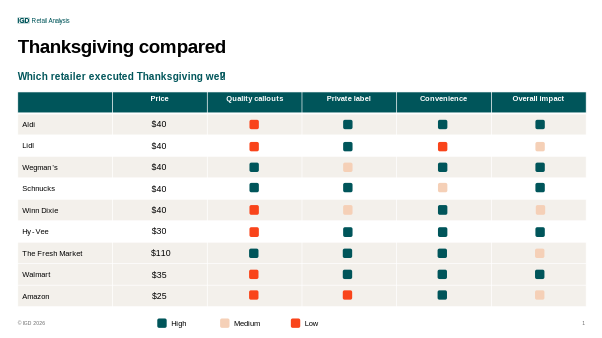
As retailers compete to attract Thanksgiving shoppers, price has become the foundation of value messaging. Discounters Aldi and Lidl provided the clearest benchmark, both launching meal bundles for under $40. Aldi reduced the cost of its basket compared with last year while increasing the size of the turkey offered, and also introduced a one-click basket available through delivery partners. Lidl focused on linking value with loyalty, using its Thanksgiving proposition to showcase broader price reductions available through its Lidl Plus loyalty scheme, although the Thanksgiving meal required a Lidl Plus account, making it somewhat of a barrier to entry.
Many traditional grocers followed suit. Wegmans launched a Thanksgiving meal serving eight for less that $5 per person, highlighting the quality of its private-label products. Schnucks offered a meal for ten at less than $4 per serving, while Winn-Dixie introduced two Thanksgiving meal options priced below $40.
Some retailers pushed value even further. Walmart offered a Thanksgiving meal for ten for $35, positioning itself below the key $40 threshold. Meanwhile, Amazon launched a 16-product meal bundle for just $25, including an eight-pound turkey and free same-day delivery.
These offers demonstrate that retailers are willing to sacrifice margin to establish value credentials during a key seasonal event. More importantly, the goal extends beyond a single Thanksgiving shop. By creating strong value perceptions, retailers aim to attract new shoppers, strengthen trust and encourage longer-term loyalty.
Convenience outshone quality as a value differentiator
While affordability remains essential, retailers recognise that shoppers view value through a broader lens than price alone. Price differentiation is almost non-existent between retailer offerings, meaning retailers must find other way to differentiate.
One approach is product quality. Wegmans placed particular emphasis on the quality of private label products included in its Thanksgiving meal bundle. This reflects wider shopper sentiment, with 72% of shoppers saying quality and value are more important than simply finding the lowest price. For retailers, communicating quality provides reassurance that shoppers do not have to compromise their Thanksgiving celebration in pursuit of savings.
However, the most significant area of differentiation was convenience. Retailers increasingly positioned convenience as a key component of value, recognising that reducing effort can be just as important as reducing spend.
Meal bundles were a common example, simplifying what is a complex mission. Instead of shoppers needing to build the basket from scratch, retailers completed the baskey for them, reducing planning time and budgeting uncertainty. Amazon, Aldi, and Walmart all made purchasing a Thanksgiving meal a streamlined process through one-click online ordering.
Delivery emerged as an important value driver. Amazon’s free same-day delivery added further convenience for shoppers, particularly those making last minute purchases. Aldi likewise integrated its proposition with third-party delivery services, making its bundle easier to access.
Retailers also sought to simplify meal preparation. Hy-Vee and The Fresh Market expanded ready-to-heat meal options, while Winn-Dixie offered both a traditional scratch cooking meal option and a heat-to-serve alternative. This dual approach allowed the retailer to appeal to shoppers seeking a traditional Thanksgiving experience while also capturing those prioritising speed and convenience.
The importance of convenience was also seen in retailers digital tools. Testing of AI-powered meal planning and shopping assistants showed mixed results, with curated baskets providing a simpler experience to conversational AI. While AI has the potential to play a bigger part, retailers are generating more value through straightforward solutions such as one-click baskets and pre-built bundles for Thanksgiving.
Thanksgiving identifies a key change in US retail strategy
Thanksgiving 2026 showed how affordability remained key, but value was being sought and offered in varying ways. The low priced meals established credibility, while convenience and quality created stand out offerings. As competition intensifies, and as shoppers continue to focus on budgets, retailers who combine low prices with reduced effort can win. Thanksgiving therefore provides an indication of how value is evolving across US grocery retail, with affordability increasingly supported convenient and simple solutions.