
From foodservice partnerships and premium ranges to smarter merchandising and digital navigation, five UK grocery retailers show how large stores can create more reasons to visit, make shopping easier and unlock additional spending.
Supermarkets and hypermarkets need to offer more than scale and choice to remain competitive.
What will it take for large stores to thrive?
As tough economic conditions and competition from discounters and online channels intensify, supermarkets and hypermarkets are rethinking how their stores operate and how to make their space work harder.
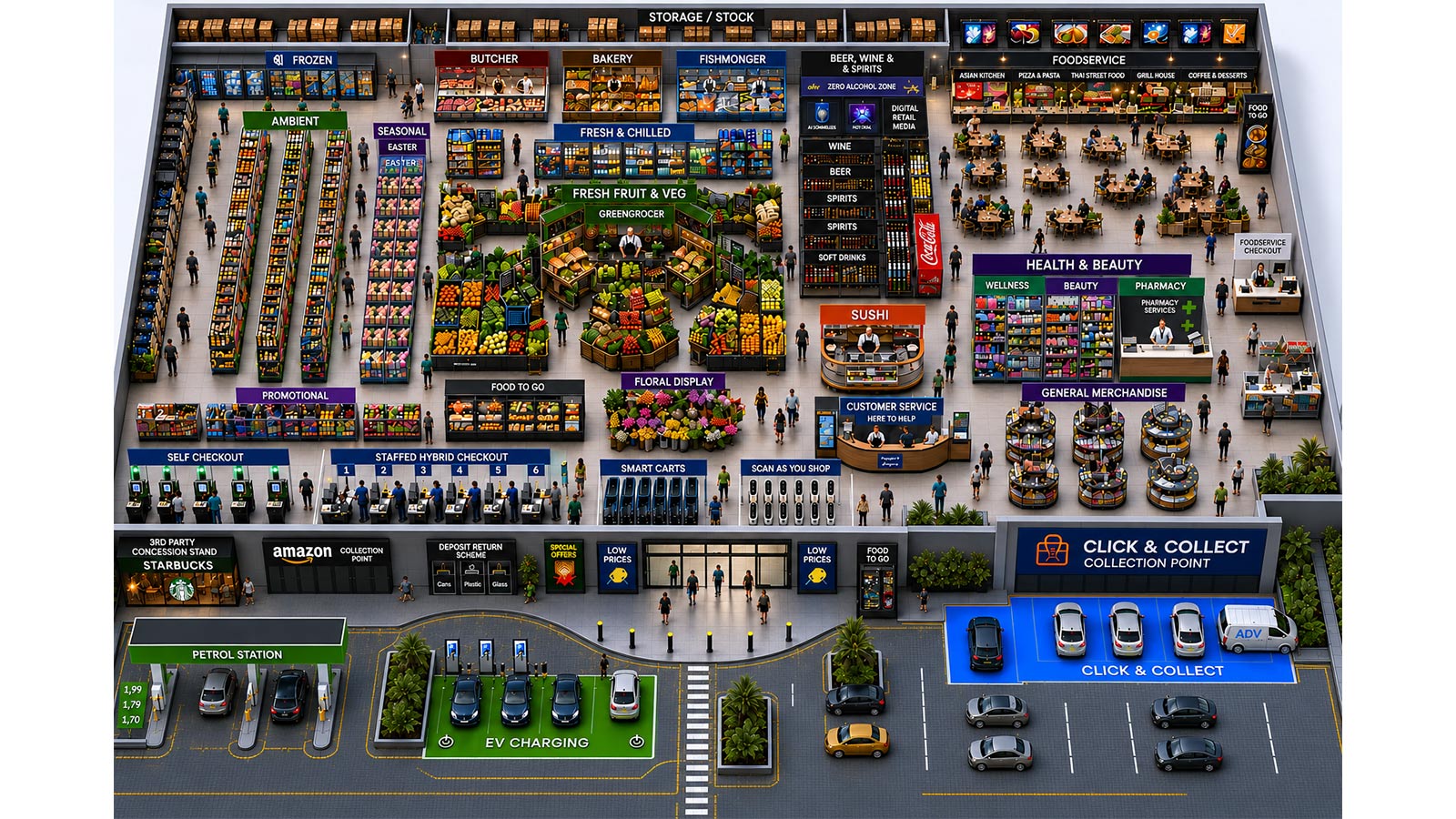
The large store of the future challenges traditional thinking and explores new possibilities for large-format retail. It helps retailers and suppliers identify growth opportunities and reimagine how store space can drive sales and improve profitability.
Large stores must continue to evolve to meet changing shopper demands, enabled by partnerships and technology. The model helps to create a blueprint to create excitement and add efficiency to drive sales. Using this model, we identified four supermarket and hypermarket trends 2026.
Explore how UK retailers are delivering excellence across supermarket and hypermarket formats.
Tesco gaining revenue through third party partnerships
Tesco is seeking to increase the revenue generated from its large stores. A prime example is its partnerships with third parties, as it grows the number of reasons for shoppers to visit sites outside of grocery shopping in the hope of picking up impulse purchases. Third party partnerships with foodservice providers has been successful throughout its stores. Tesco has partnered with the likes of Greggs, sushi and Japanese specialists and Costa Coffee machine in its food-to-go offer.
Tesco is creating more reasons to visit beyond the weekly shop. Foodservice partnerships can attract shoppers for breakfast, lunch or coffee, helping retailers generate more frequent visits and additional impulse purchases.
Sainsburys combining premium and value
Sainsbury’s is combining competitive value with a growing premium offer. Taste the Difference sales now exceed £2 billion, with fresh lines growing 16% year-on-year. Around 69% of shoppers buy both Aldi Price Match and Taste the Difference, demonstrating how value and quality can appeal to the same customers. Continued innovation is supporting strong growth in the premium range and attracting more shoppers across categories.
Sainsburys is giving shoppers clear reasons to trade up. Premium growth requires more than higher prices. Investing in distinctive products, quality and innovation that justify the extra spend, encouraging shoppers to explore premium ranges across more categories.
M&S elevates produce through quality and smarter merchandising
M&S fresh produce category is built around premium quality, trusted sourcing, British seasonality, product innovation and sustainability. M&S focuses on delivering products that customers perceive as superior in taste, freshness and quality.
M&S is also adopting a blended merchandising approach, placing frozen fruit alongside chilled packaged fruit. Common in its larger new stores, this approach groups products by food category rather than temperature zone, making shopping more convenient and enhancing the in-store experience.
Overall, M&S continues to make premium quality tangible to shoppers. Combining taste and freshness with clear sourcing and seasonality messages to give shoppers compelling reasons to choose the range and justify spending more.
Morrisons connects shoppers to shelves with Shop to Light
Morrisons has partnered with VusionGroup to introduce electronic shelf labels (ESLs), pick-to-light technology and connected shelf-edge solutions. Pick-to-light technology already supports colleagues picking online orders, the flashing labels now help customers locate products through Shop to Light, launched in the Morrisons More Card app in November 2026. Shoppers search for a product, select the option to flash its label and confirm they are in the correct aisle. The corresponding ESL then flashes magenta to identify the product.
Morrisons is using technology to solve everyday shopping frustrations. Helping shoppers locate products can make large stores easier to navigate and reduce the risk of purchases being abandoned because items cannot be found.
Morrisons Shop to Light
Asda builds excitement around seasonal moments
Asda is turning key retail moments throughout the year into high-impact shopping experiences that drive footfall, increase basket spend and encourage impulse purchases. As Christmas approaches, Asda is combining seasonal product ranges, promotional pricing, visual merchandising, in-store theatre and coordinated marketing campaigns.
Asda is coordinating its Christmas offer to turn excitement into spending. Aligning marketing, promotions and product placement can help convert seasonal interest into larger baskets. Clear value messaging should make it easy for shoppers to participate without feeling they need to overspend.
What can you learn from these grocery retailers?
1. Use partnerships to make store space work harder
Bringing in complementary specialists can broaden the offer without developing every capability in-house. Retailers should assess partners on both their direct revenue contribution and their ability to drive spending elsewhere in the store.
2. Treat value and premium as complementary, not competing priorities
Shoppers can save on everyday essentials while trading up elsewhere in the same basket. Retailers should combine competitive entry-level pricing with compelling premium options to capture both needs.
3. Organise products around shopper needs, not operational boundaries
Placing complementary fresh and frozen products together can simplify navigation and help shoppers discover alternatives. Retailers should test where cross-temperature merchandising makes shopping easier and supports additional purchases.
4. Make digital investment work for colleagues and customers
Extending pick-to-light from online order picking to shopper navigation shows how the same infrastructure can support operational efficiency and customer convenience, creating more value from the investment.
5. Make seasonal moments a reason to visit, not just a product display
Retailers can combine seasonal ranges with in-store theatre and eye-catching merchandising to create experiences that encourage discovery and impulse purchases.